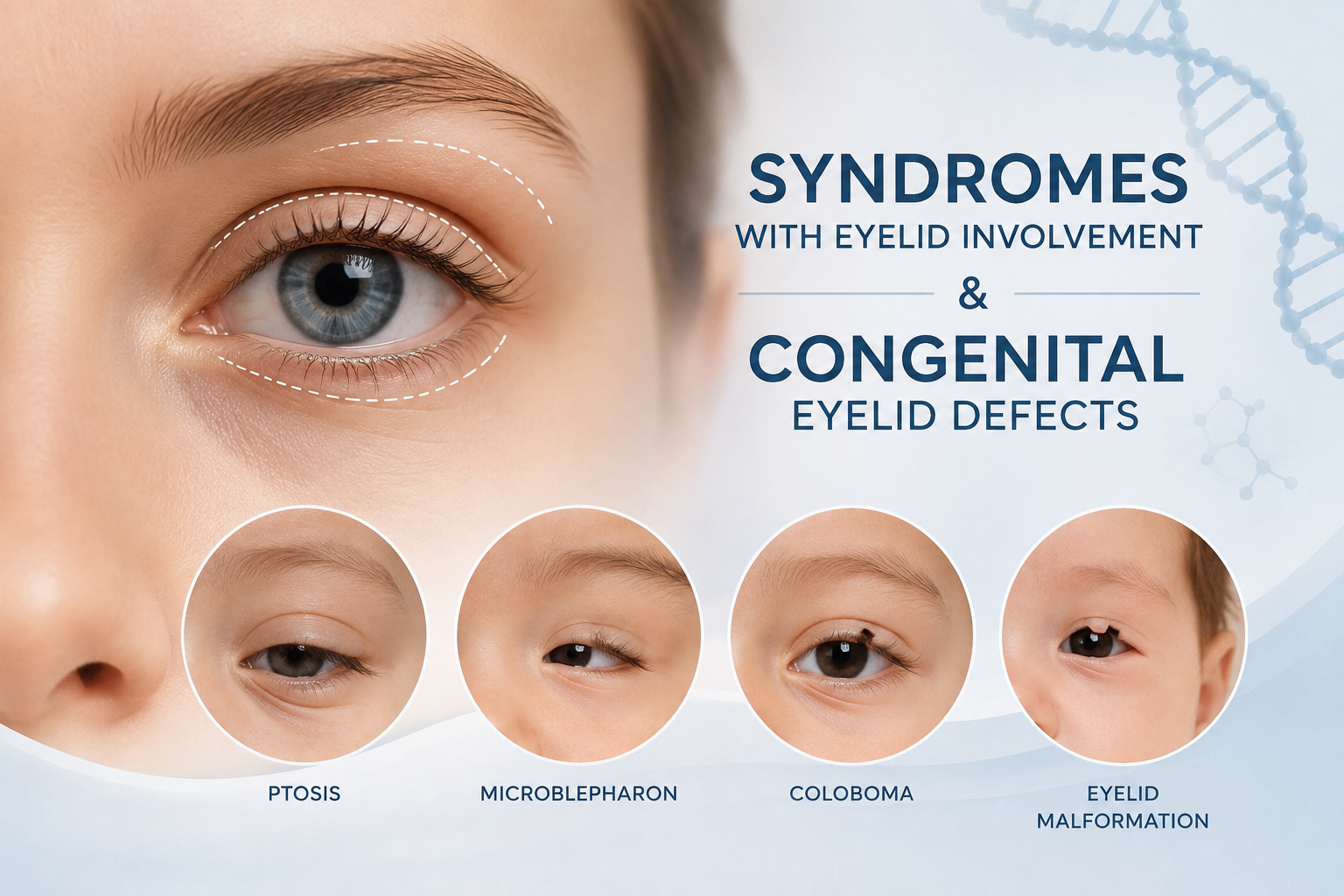

Syndromes with eyelid involvement and congenital eyelid defects
Syndromes with Eyelid Involvement & Congenital Eyelid Defects
A clinical selection of neurogenic, myogenic, and dystrophic syndromes commonly encountered in eyelid surgery practice. These conditions present as congenital or acquired defects and are frequently linked with upper eyelid ptosis.
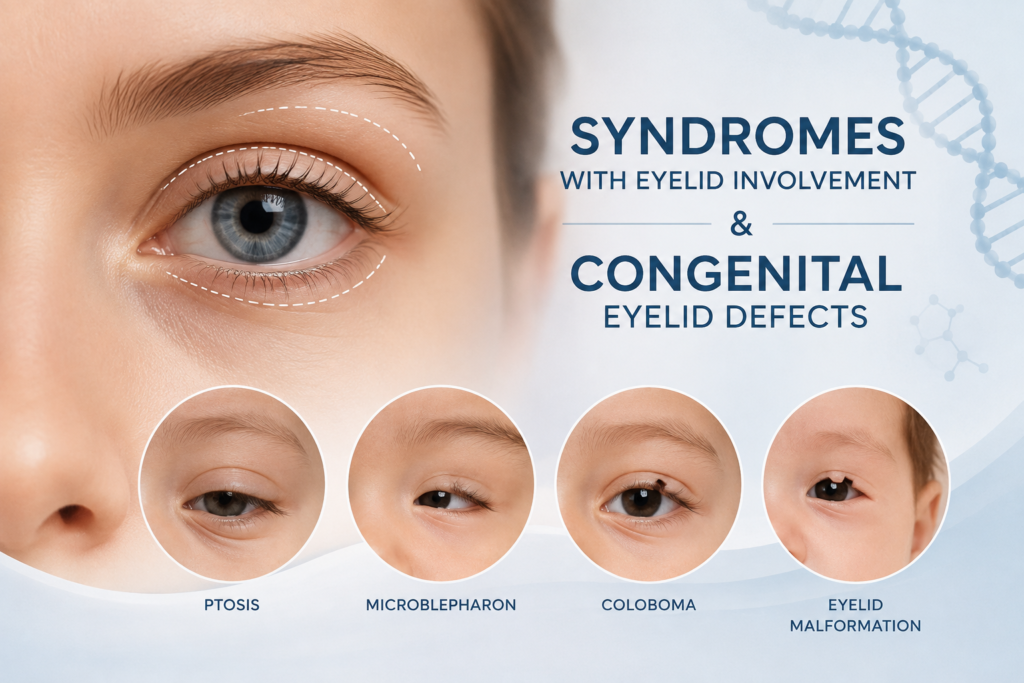
Eyelid Syndromes & Congenital Defects
A comprehensive breakdown of specific neurological, muscular, and structural anomalies associated with eyelid pathophysics and ptosis.
Neurogenic Conditions
Oculomotor Nerve Palsy
Ptosis accompanied by impaired eye motility due to 3rd cranial nerve palsy.
Horner's Syndrome
Ptosis resulting from disruption of the sympathetic nerve supply to the eyelid.
Marcus Gunn Jaw-Winking
Neurogenic anomaly causing involuntary eyelid movement during chewing.
Blepharospasm
Neurogenic involuntary eyelid closure creating a strong tendency towards ptosis.
Blinking Apraxia
Neurogenic delay or inability to initiate blinking, leading to functional ptosis.
Facial Palsy
Inability to close the eyelid due to facial nerve paralysis, often with brow ptosis and ectropion.
Myogenic & Dystrophic Disorders
Simple Congenital Ptosis
Ptosis caused by an isolated developmental defect of the levator palpebrae superioris muscle.
Fuchs Syndrome (Blepharochalasis)
Ptosis associated with atrophy of all eyelid structural layers and supporting ligaments.
Floppy Eyelid Syndrome
Severe eyelid drooping and laxity caused by complete loss of tarsal elasticity.
Neurofibromatosis (Recklinghausen)
Mechanical ptosis resulting from neurofibroma thickening within the upper eyelid.
Structural & Congenital Anomalies
Blepharophimosis Syndrome
Complex ptosis combined with marked vertical and horizontal narrowing of the palpebral fissure.
Eyelid Coloboma
Congenital full-thickness cleft or defect of the upper or lower eyelid margin.
Epicanthus
Congenital vertical skin fold over the inner canthus ("Mongolian fold").
Distichiasis
Formation of a second accessory row of eyelashes causing mechanical friction on the cornea.
Anophthalmos
Absence of the eyeball or disturbed globe development leading to secondary ptosis.
Comprehensive Oculoplastic Assessment
Managing congenital eyelid defects and complex neurogenic syndromes requires specialized surgical planning. Schedule a clinical consultation for an accurate diagnostic breakdown and tailored reconstructive strategy.
BEFORE & AFTER